
An ASIC, or application-specific integrated circuit, is a chip designed for a particular purpose, with applications ranging from communications and image processing to AI computing. AI-specific chips co-design compute units, memory and data movement around the computational requirements of neural networks.
Google, AWS and Meta continue to invest in their own AI chips, making specialized accelerators an important option in how major platforms plan compute capacity. Google TPUs accelerate machine-learning workloads. AWS targets training and inference with Trainium and Inferentia, while Meta uses MTIA to support workloads such as recommendation and ranking within its own services.
These platforms have sustained, large-scale computing needs and can co-design models, software and hardware to pursue a better balance of performance and cost. As AI services expand, competition in specialized chips is also extending to independent accelerator vendors, server systems and inference clouds, creating multiple technical and commercial approaches.
Recent developments among other vendors illustrate different paths to commercialization. In September 2026, d-Matrix announced its adoption of NVIDIA NVLink Fusion, with plans to connect its next-generation Raptor accelerator to NVIDIA rack architectures. Cerebras announced a partnership with Gimlet Labs to connect wafer-scale computing to inference cloud services. Alongside Rebellions' rack platforms, SambaNova's reconfigurable dataflow architecture and Groq's low-latency inference services, competition is expanding beyond chip performance to system integration and service delivery.
How ASICs, GPUs, NPUs and TPUs Differ
ASIC describes a chip designed for a specific purpose; GPUs excel at parallel computing; and NPU is a general term for a neural processing unit. Understanding these names helps clarify the design choices made by AI chip vendors.
| Term | How to Understand It | Design Focus |
|---|---|---|
| ASIC | Application-specific integrated circuit | Designed for specific computations and data paths; commonly used in communications, imaging and AI. |
| GPU | A processor capable of many types of parallel computation; AI GPUs also contain specialized matrix-computing units. | Supports multiple workloads through programmable parallel computing and a software ecosystem. |
| NPU | A general term for a neural processing unit, with implementations varying significantly between vendors. | Accelerates common neural-network computations in both end devices and data centers. |
| TPU / LPU / RDU | Vendor-specific names and architectural approaches for accelerators. | Represent the accelerator approaches of Google, Groq and SambaNova, respectively. |
Specialized chips can use compilers to support multiple models. For example, Google TPUs execute tensor operations, while Rebellions uses an SDK to connect with model frameworks. Software converts models into computations that the hardware can execute.
Sustained Inference Demand Creates Opportunities for Specialized Chips
Inference is the computation performed repeatedly after a model enters service. Each response from a customer-service assistant, search summary or AI agent consumes compute capacity. As requests accumulate, response speed and energy consumed per computation become important components of service cost.
Training focuses on building and updating models, while inference requires trade-offs between user waiting time, concurrent requests and cost. For example, online customer service values the time until the first response appears, whereas batch document processing places more emphasis on how much work is completed over a period of time. The same chip may offer different value in these two situations.
This makes memory capacity, data movement and system interconnects important areas of competition. Chip vendors aim to shorten the movement of data between memory and compute units, while pairing the hardware with compilers, model support and serving frameworks to translate hardware efficiency into practical applications.
Comparing Six Specialized AI Chip Vendors
Beyond the in-house chips developed by major platforms, the following six vendors illustrate different technical and market entry points. Some provide accelerator cards, some deliver complete computing systems, and others offer inference through cloud APIs. Comparing these six helps explain how specialized chips reach the market and where each vendor focuses its architecture and delivery model.
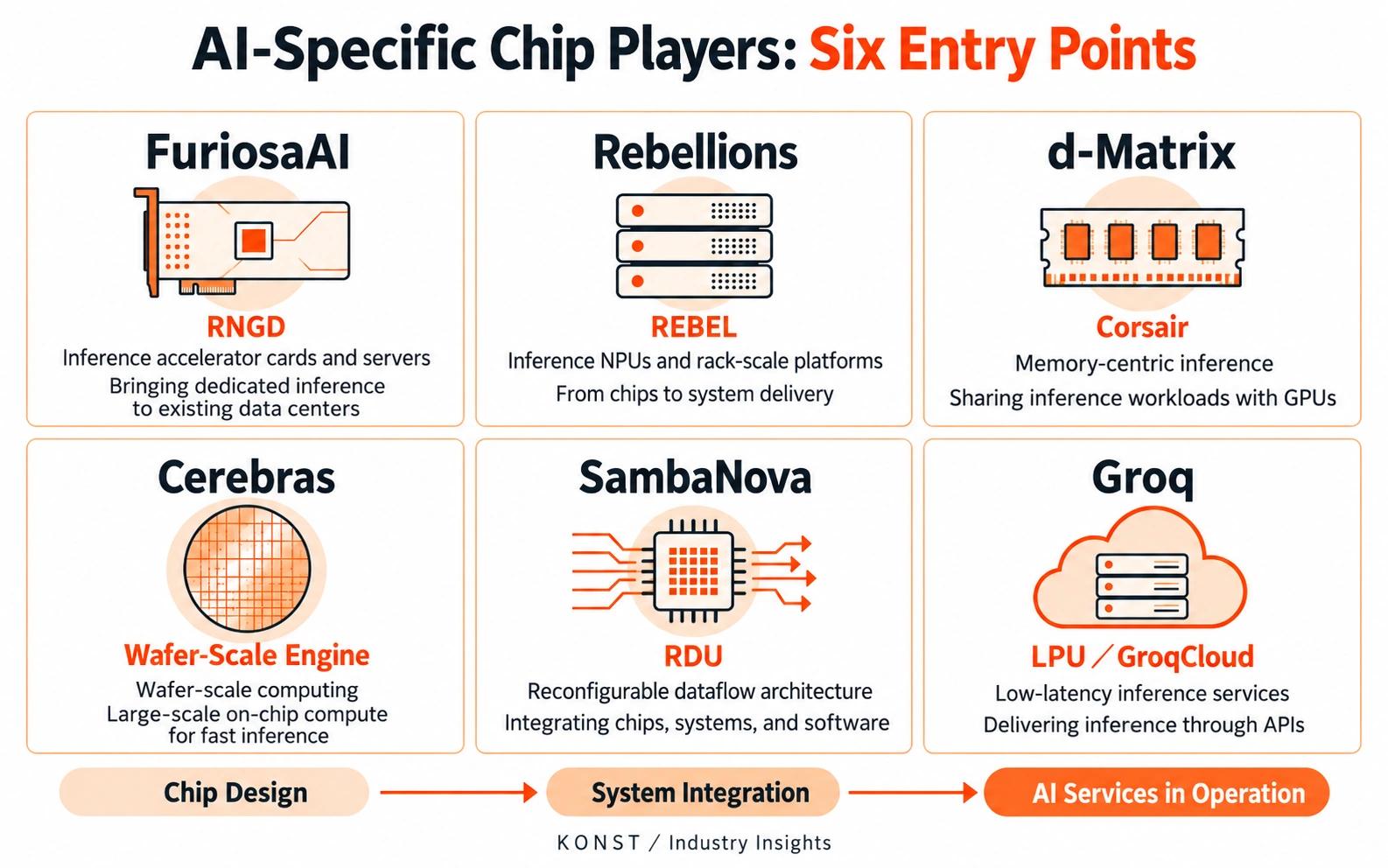
| Company / Representative Technology | Technical Approach | Market Position |
|---|---|---|
| FuriosaAI / RNGD | Pairs the RNGD inference accelerator with PCIe cards and servers. | Brings specialized inference to enterprise and data center environments. |
| Rebellions / REBEL | Inference NPUs, chiplet designs and software tools. | Extends from chips to system platforms such as RebelRack and RebelPOD. |
| d-Matrix / Corsair | Co-designs memory and computing to reduce data movement. | Pairs Corsair with GPUs for low-latency inference and rack-scale deployment. |
| Cerebras / Wafer-Scale Engine | Integrates large amounts of compute and on-chip memory in a wafer-scale engine. | Provides computing systems and high-speed cloud inference services. |
| SambaNova / RDU | Combines a reconfigurable dataflow architecture with software. | Integrates chips, systems and an enterprise inference platform. |
| Groq / LPU and Inference Services | Uses LPUs to accelerate inference, emphasizing low-latency generation. | Delivers inference capabilities through the GroqCloud API. |
These approaches are also beginning to converge through partnerships. In December 2025, Groq and NVIDIA announced a non-exclusive inference technology licensing agreement. NVIDIA also recruited Groq's founding team, illustrating how the boundary between independent vendors and platform companies is shifting. Meanwhile, d-Matrix's Corsair works alongside GPUs, dividing prompt processing and subsequent token generation between them. Specialized chips are taking on a broader role in heterogeneous computing systems.
Three Business Models for Specialized Chips, from Internal Use to External Services
The commercialization model for a specialized chip depends on the vendor's customer relationships and system capabilities. Large platforms can first serve their own workloads and then expand into cloud services. Independent chip vendors need to enable other enterprises either to deploy their hardware or to use their compute capacity directly.
1. Large platforms co-design chips and workloads. Google TPUs and AWS Trainium are integrated with their respective cloud platforms, while Meta MTIA is designed for internal needs such as recommendation and ranking. These platforms can bring application requirements directly into chip and system planning, with sustained computing demand supporting development investment.
2. Accelerator vendors turn chips into deployable systems. FuriosaAI brings RNGD accelerator cards and servers into data centers, while Rebellions is developing rack platforms. This approach requires model tools, server configurations and interconnect capabilities to be delivered together so that customers can incorporate the chips into existing computing environments.
3. Cloud services lower the barrier to adopting hardware. The GroqCloud API and Cerebras inference services give developers direct access to compute capacity. These models concentrate equipment deployment and operations on the service-provider side, extending competition to model support, response speed and the ability to sustain service delivery.
The Next Stage for AI Chips: Workload Specialization and System-Level Competition
1. Inference hardware will become more specialized by task. Prompt processing and incremental token generation have different computational characteristics, and the combination of d-Matrix and GPUs already illustrates this direction. Future platform competition will include how effectively different tasks are assigned to suitable accelerators.
2. The unit of competition will expand from chips to systems. Major cloud providers integrate their own chips with their platforms, while specialized accelerator vendors add servers, interconnects and model tools. Whether hardware efficiency becomes useful service capacity depends on how the complete system works together.
3. Enterprises will have more ways to access compute capacity. They can use specialized chips through cloud services or deploy accelerators in their own environments. As software interfaces and model tools mature, connecting hardware architectures with higher-level applications becomes easier.
The development of ASICs is bringing more specialized roles to AI computing. Large platforms, chip vendors and system integrators each have a part to play. The next stage of competition will center on efficiency for specific workloads, deployable systems and computing services that can be delivered consistently.
Deploying Heterogeneous Compute Requires Data Center and System Integration
When GPUs and specialized accelerators share AI workloads, deployment must also integrate the power, cooling, networking and maintenance requirements of different devices. As computing moves beyond a single chip architecture, facility capacity, data exchange between systems and future expansion all affect whether services can be brought into operation.
KONST Group supports new-build, retrofit and expansion requirements for AI data centers. Its Konstra AI brand provides mechanical and electrical systems, environmental controls, GPU cluster construction and ongoing operations and maintenance. When planning different types of computing equipment, enterprises can start with the target system's specifications to discuss rack configurations, power and cooling capacity, and the division of interface responsibilities between equipment and on-site facilities.
Contact KONST to discuss AI data center and compute integration requirements.