Vera Rubin is NVIDIA's next-generation computing platform for large-scale AI training and inference. It combines Vera CPUs, Rubin GPUs and high-speed interconnects. The platform addresses a growing need: as AI moves from answering individual questions to reasoning over multiple steps, using tools and completing tasks, it must process more data and perform more computation.
According to NVIDIA's quarterly earnings call, volume shipments of Vera Rubin began in August 2026. For businesses, the next questions are which bottlenecks the platform addresses, how to interpret its performance figures, and what it takes to turn those improvements into usable compute capacity.
Vera Rubin's Progress: From Announcement to Volume Shipments
Vera Rubin has moved from announcement to volume shipments. When a business can buy a system or rent capacity still depends on the deployment region, available capacity and service launch date. Manufacturer shipments and a customer-ready environment are different stages in the supply chain.
| Timing | Public milestone | What it means for businesses |
|---|---|---|
| January 2026 | NVIDIA unveiled Rubin at CES, announced full production and said partner products would become available in the second half of the year. | The platform roadmap was established; rental capacity in each region still required confirmation. |
| August 2026 | On Aug 26, 2026, NVIDIA confirmed in its earnings call that volume shipments had begun that month. | Equipment vendors and compute providers could proceed with integration and deployment as supply moved into delivery. |
| Customer deployment | Confirm installation, testing and ready-for-use dates against the hardware delivery schedule or cloud service plan. | Plan procurement around when workloads can actually begin running. |
After equipment arrives, liquid cooling must be connected, networking configured and models tested before production work can begin. Cloud customers also need to confirm that their chosen region offers the required scale.
Understanding Vera, Rubin and the Platform Architecture
Vera is the CPU; Rubin is the GPU. The Vera Rubin platform brings them together with interconnects, networking and software in a coordinated design. These distinctions help explain whether a performance claim refers to a chip, a rack-scale system or an entire AI data center.
For example, Vera Rubin NVL72 combines 36 Vera CPUs and 72 Rubin GPUs in one rack-scale system, with sixth-generation NVLink enabling high-speed data exchange between GPUs.
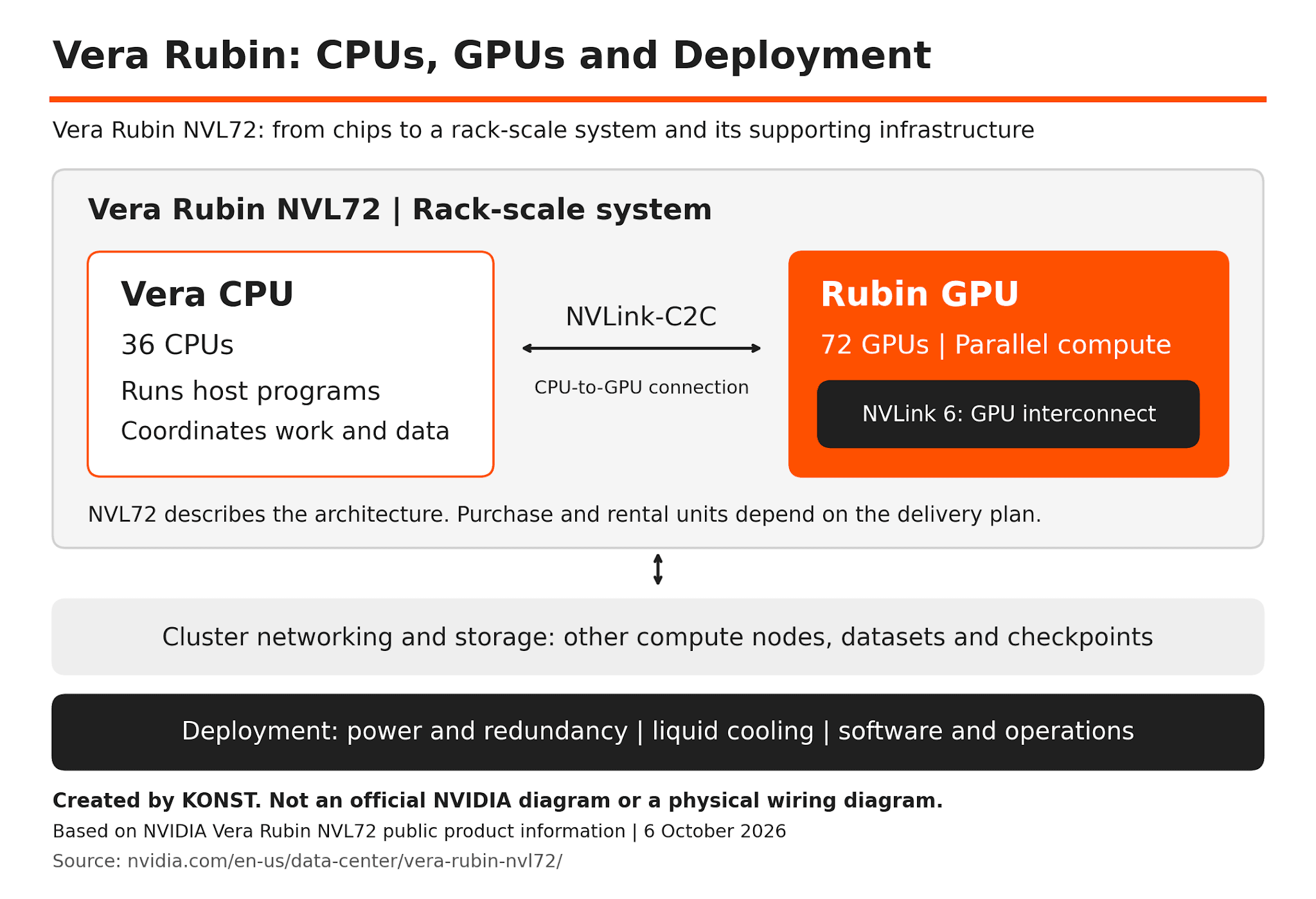
Figure: Vera Rubin NVL72 functions and system layers. Created by KONST from NVIDIA's public product information; this is not an official NVIDIA diagram.
Each component serves a different purpose. CPUs run host programs and coordinate work; GPUs handle the model's parallel computation; NVLink helps GPUs exchange data efficiently. Cluster networking then connects the system to other compute nodes and storage so it can handle larger workloads.
This is why platform design matters. When a model spans multiple GPUs, performance depends on data movement, interconnects and software scheduling as well as raw computation. A single GPU's peak performance captures only part of that picture.
Why AI Agents Need More Compute
To complete a task, an AI agent may call a model repeatedly, read tool results and accumulate context. As tasks get longer and more users run them at once, inference speed, memory and data transfer efficiency all affect completion time and cost. These are key areas that newer compute platforms aim to improve.
For a procurement research task, an agent might search for information, read documents, compare requirements, investigate gaps and produce a report. Each new piece of information can trigger another round of inference. Longer tasks may also require the model to retain more context.
These workloads create three compute requirements:
- Longer context: Documents, conversation history and tool outputs must remain available to the model. GPU memory and data access efficiency affect how much work the system can handle.
- Faster repeated inference: Time saved on each response can add up across an entire task. Response times must also remain acceptable when many users share the service.
- Efficient GPU communication: Large models span multiple GPUs, and data exchange affects how much time those GPUs spend doing useful work. This is especially relevant to mixture-of-experts (MoE) models, which route computation among expert modules. NVIDIA's Rubin technical overview describes a coordinated approach to computation, interconnects and inference context management. An agent's overall speed also depends on search, external APIs and tool execution. If most of the waiting happens in those steps, faster GPUs can improve only part of the workflow.
Will Lower Inference Costs Make AI Services Cheaper?
Vera Rubin's inference efficiency may reduce the system cost of generating tokens. Whether cloud rental prices or model API rates fall depends on providers' pricing decisions. Performance multiples are meaningful only alongside the compared platforms, models and test conditions.
In its January 2026 announcement, NVIDIA said Rubin could reduce inference token costs to as little as one-tenth of those on Blackwell. This claim applies to the stated platform comparison. It does not establish a 90% price reduction for every AI service or a universal improvement factor over GB300.
As hardware and software evolve, later publications may report different performance multiples. Check whether a comparison covers one NVL72 system or a broader configuration with additional inference equipment, and whether the figures are measured or projected.
| Cost category | What it measures | How to compare it |
|---|---|---|
| System computing cost | Hardware, power, cooling and operating costs relative to useful output | Compare cost per unit of output using the same model, quality target and latency requirement. |
| Cloud compute price | The fee for using GPUs, servers or dedicated capacity | Account for region, rental term, capacity guarantees and included services. |
| Model API rate | Charges for model inputs, outputs or other usage | Check the actual rate card; model services, product strategy and commercial pricing also affect rates. |
For an enterprise inference service, a more useful question is: how many requests can it complete each month while meeting the same quality and response-time requirements? For AI agents, measure the total cost per successful task, including repeated inference, tool fees and retries.
This shows whether better hardware efficiency translates into lower business costs, beyond a higher peak performance figure.
What Changes for Enterprise Deployment
Deploying Vera Rubin requires coordinated planning for the equipment and the facility. In a rack-scale system such as NVL72, power, liquid cooling, interconnects and software all affect the launch date and sustained performance.
Size power for the whole system. Compute racks, networking, storage and cooling equipment all need power, with allowance for redundancy and changing loads. Check available capacity against the actual configuration and include future expansion in the plan.
Cooling must connect correctly and remove the heat. Vera Rubin NVL72 uses direct liquid cooling. Confirm the coolant distribution unit (CDU), piping and heat rejection capacity for the target configuration. Agree who handles installation, testing and maintenance so facility work aligns with equipment delivery.
Match networking and storage to the workload. GPU interconnects inside a rack and cluster networks between racks serve different roles. Large training jobs that exchange data across racks or frequently access datasets and checkpoints need network and storage testing alongside compute testing, so GPUs spend less time waiting for data.
Validate software with real tasks. Drivers, compute frameworks, inference engines and model settings jointly determine performance. Confirm that existing models run correctly on the new hardware, then test latency, throughput and stability with representative workloads.
Compute providers typically handle much of this deployment work for rental customers. Businesses still need to establish whether the service includes hardware access, a configured cluster or ongoing software management, so operating responsibilities match expectations.
How KONST Supports Next-Generation AI Compute
KONST Group provides GPU bare-metal rental and dedicated cluster services. KONST's infrastructure brand, Konstra AI, delivers AI data center infrastructure, from mechanical and electrical systems and environmental controls to GPU clusters, equipment operations and compute delivery. Businesses can choose existing capacity or plan a dedicated environment based on their launch date, compute scale and site conditions.
Teams ready to run models and development workloads can explore GPU bare-metal services to confirm suitable hardware and delivery terms. Businesses planning sustained GPU growth can coordinate cluster deployment with AI data center construction, aligning power, cooling and operations with expanding workloads.
Specific Vera Rubin offerings, locations and delivery schedules require separate confirmation. KONST can begin with compute and facility planning, then arrange deployment based on confirmed equipment and capacity.
Discuss your AI compute and deployment requirements with KONST