GPT-6 Astra is an OpenAI model designed for complex work that involves reasoning, tool use and sustained execution. It reflects a broader shift in AI: from answering questions to researching information, changing code and producing documents. Strong results on specific benchmarks, however, are not enough to establish that it has achieved artificial general intelligence (AGI).
For users, the practical questions are what Astra can help complete, whether it needs less guidance and correction than earlier models, and which tools and data must be in place before it can work.
GPT-6 Astra, ChatGPT and the API: What Is the Difference?
GPT-6 Astra is the model that interprets information, reasons and generates content. ChatGPT is a product people use to interact with AI. An API lets developers connect a model to their own applications. The same model can have different tools, data access and permissions depending on the product through which it is used.
Asking for a research outline in a chat window is different from allowing AI to read company documents, search the web and create editable files. The latter requires document access, search and file-generation tools, together with clear authorization.
The GPT-6 Astra model documentation describes capabilities in reasoning, coding, computer use, research and document work. These provide a foundation for applications; the actions a model can perform depend on the tools connected to the platform.
Has GPT-6 Astra Achieved AGI?
Public evidence supports significant progress on some complex tasks, but does not establish a definitive conclusion that Astra has achieved AGI. The term generally describes AI that can learn, understand and perform work across a broad range of domains. Any assessment needs to define the breadth of capability, reliability and testing conditions.
A benchmark with AGI in its name is not an AGI certification. In ARC Prize's evaluation of Astra, the model scored 62.7% on ARC-AGI-3 Semi-Private in the standard evaluation harness at max reasoning effort. With the provider's harness, which preserves reasoning state, it scored 99.9% at high reasoning effort.
AI outcomes depend on the model and its working environment together. Complete information, retained context from earlier steps and available tools can all change the result. Businesses should therefore evaluate completion rates and the need for human review on their own tasks.
What Improves over GPT-5.6 Sol?
Compared with GPT-5.6 Sol, Astra is better at staying focused and consistent during long tasks and following longer, more complex instructions. It is also more inclined to ask about unclear requirements. Whether this reduces rework and human effort should be tested with the same tasks.
OpenAI's model guide describes improvements in long-task consistency, instruction following, and the ability to incorporate new requirements and clarify questions during work. These behaviors affect how the model collaborates with users.
| Area | Capabilities and differences described by OpenAI | What it means for users |
|---|---|---|
| Multi-step work | Astra maintains consistency through long tasks better than GPT-5.6 Sol. | Useful when goals, constraints and background must remain in view over many steps. |
| Instruction following | Astra follows longer instructions better than earlier models and responds more strongly to guidance documents. | Complex requirements are easier to apply; outdated or conflicting instructions need attention. |
| Changes during a task | Astra can incorporate new requirements, change direction and continue the original task. | Users can steer work in progress; results should be checked in the chosen interface. |
| Clarification | Astra is more likely to ask first; earlier models such as GPT-5.6 Sol are more likely to make assumptions. | Specify which decisions it may make independently to avoid unnecessary pauses. |
These are descriptions of model behavior, rather than a fixed time saving for every task. An existing model may already handle a short, standardized summary reliably. Long-task capabilities become more relevant when work involves reading multiple documents, reconciling conflicting information and revising an output.
OpenAI's published evaluations show further differences between Astra and GPT-5.6 Sol. The chart covers workflow automation, terminal tasks, computer use and web research, reflecting work that ranges from finding information to using tools to complete a task.
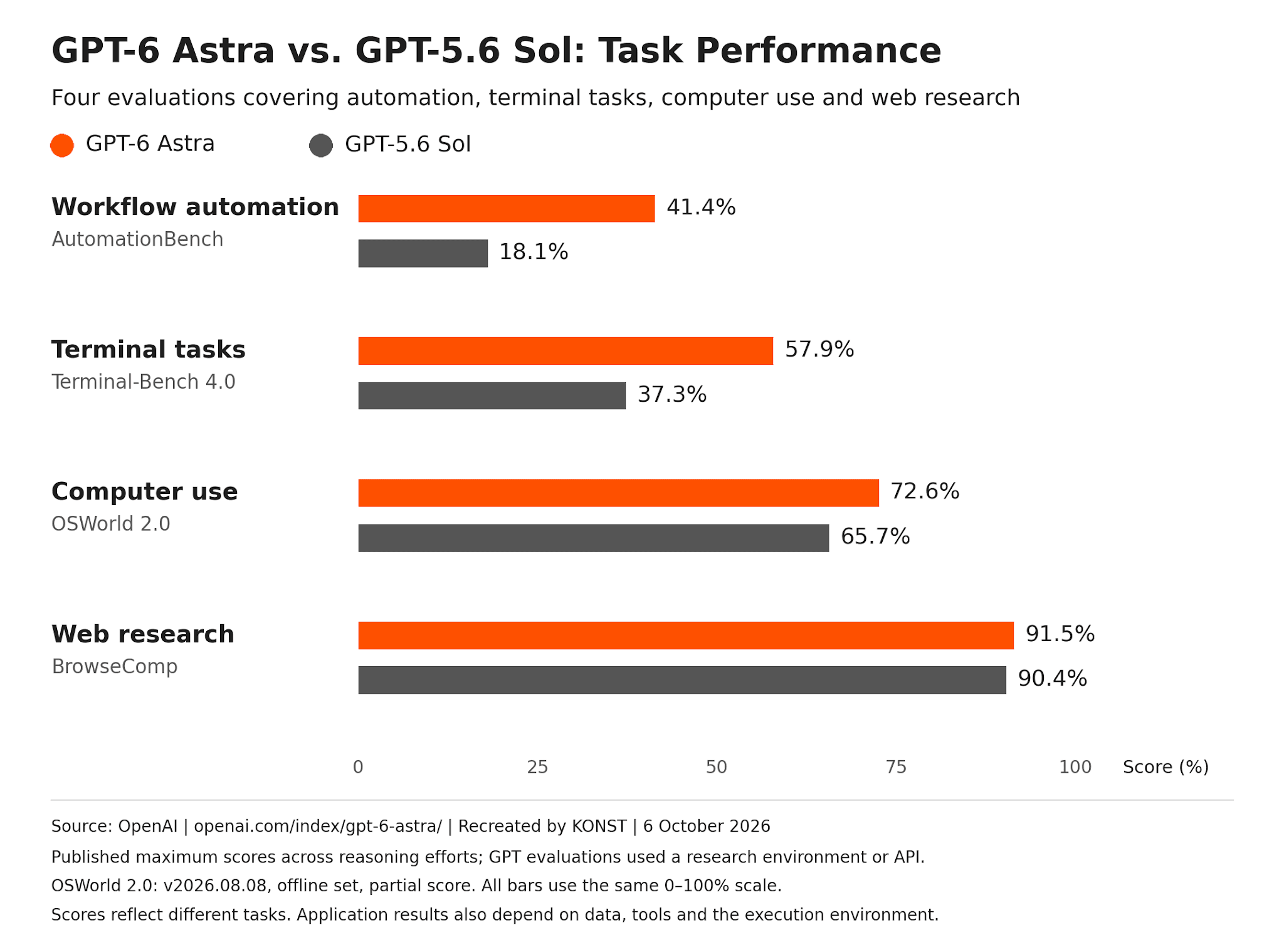
Figure: GPT-6 Astra and GPT-5.6 Sol across four task evaluations. Source: OpenAI; chart recreated by KONST. Evaluation versions and conditions are noted in the figure.
The gap between Astra and GPT-5.6 Sol is larger in workflow automation and terminal tasks, and smaller in web research. The value of upgrading therefore depends on the work. For tasks involving several tools, test completion rates and the number of human interventions. For research tasks the current model already handles reliably, compare speed and cost as well.
What Work Can Astra Complete?
With the necessary data and tools, Astra can support research, document production and code changes. Define both the deliverable and its acceptance criteria so there is a clear way to check whether the task is complete.
The following examples connect the expected output with the tools and checks it requires:
| Task | Expected output | Required environment and checks |
|---|---|---|
| Research | Topic summaries, comparison tables and source links | Provide search or document-reading tools. Check source dates, citations and the reasoning behind conclusions. |
| Document production | A report or proposal based on an existing template | Provide source data, examples and file tools. Check figures, structure and layout. |
| Code changes | Updated code with relevant checks completed | Provide the repository and execution environment. Verify requirements, test results and the scope of changes. |
A research request can become more specific than 'research this market': 'Compare three options, include source dates and links, and produce a report using this template.' That gives the model a clearer basis for selecting information and producing the result. If information is missing, it can decide whether to investigate further, flag the gap or ask the user.
Sending messages externally, publishing content or changing production systems also requires application-level permissions and confirmation procedures. Permission to create an output is separate from permission to act on a company's behalf.
Astra's Limitations and Who Should Consider Upgrading
Astra is worth evaluating for people who regularly handle long tasks across multiple tools and spend substantial time adding instructions or correcting outputs. If the existing model already performs reliably, first establish how much practical improvement an upgrade would bring.
Astra can still misread data, miss constraints or produce work that needs correction. Research sources, calculations and code behavior need verification. In a multi-step task, an early mistake can affect later results, making a final review against the original requirements important.
Stronger capabilities come with tradeoffs. OpenAI's guide notes that Astra may sometimes be overly cautious, provide too much detail or perform more checks than necessary. Clear completion criteria, boundaries for independent decisions and conditions for asking questions can reduce unnecessary back-and-forth.
Use a representative set of real tasks, with the same data, tools and completion criteria, to compare:
- Output quality: Are the information and calculations correct, and does the result meet the original requirements?
- Human effort: How many follow-up instructions are needed, and how much time goes into reviewing and revising the work?
- Completion time: How long does it take to move from the initial request to a usable result?
- Total cost: Model and tool fees, plus human effort and the cost of failed attempts or rework. A faster individual response or a lower token rate captures only part of the value. A more capable model may be worthwhile if it reduces repeated rework. A lighter model may be sufficient for large volumes of simple, standardized tasks. Real workload testing is the basis for both decisions.
Use Astra through Horizon AI's ATP Token Platform
Horizon AI provides AI application implementation and model asset governance services. GPT-6 Astra is already available through Horizon AI's ATP Token platform. Businesses can connect Astra to their applications and centrally manage access to multiple models, project permissions and usage.
Through Horizon AI's ATP Token platform, teams can create project-specific keys, select permitted models and review usage records and cost attribution. Start by creating a project and key, configure the API endpoint using the developer documentation, then select Astra for testing.
The platform also offers models from Claude and Gemini. Teams can compare output quality, response time and cost on the same research, document or coding tasks, then select the right model for each type of work.
Start using Astra through Horizon AI's ATP Token platform, or talk to KONST Group about enterprise AI applications and model integration.